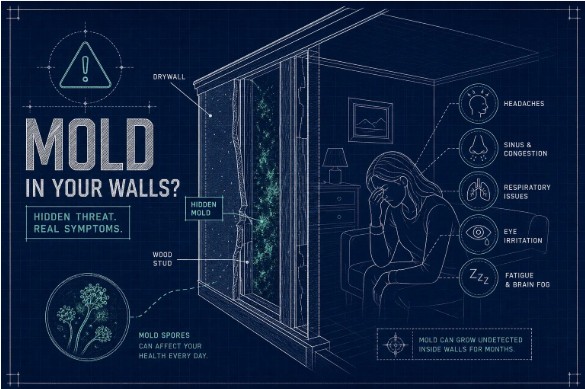
Mold behind walls doesn't announce itself. There's no alarm, no visible patch on day one, no obvious moment where you realize something is wrong. Mold in walls symptoms often begin long before anything is visible — visible mold usually indicates established growth that may have been present for weeks, with airborne spores circulating throughout that period.
At Expert Restoration, we walk into homes where families have been chalking their symptoms up to seasonal allergies or an aging house, when the real source is sitting inches behind the drywall. The symptoms show up in two places: the walls themselves and the bodies of the people living inside. This article covers all eight mold in walls symptoms, explains how to tell the difference between a stain and active growth, and lays out exactly when it makes sense to call a certified specialist versus handle it yourself.
What the wall surface is trying to show you
Symptom 1: Discoloration, staining, and patchy spots
Mold on or near a wall surface can show up as black, green, gray, brown, or yellow patches. Color alone doesn't tell you what species you're dealing with, and it doesn't tell you how deep the growth goes. What it does tell you is that moisture has been sitting in that area long enough for something biological to take hold.
Water staining and mold growth are often confused for each other, and the distinction matters. A water stain is usually a flat, uniform discoloration with clear ring-shaped edges — the kind you'd expect from a drip that dried. Active mold looks different: irregular clusters, sometimes fuzzy or powdery, with colors that spread rather than fade at the edges. Paint discoloration sometimes appears even before mold has broken through the surface, which means visible staining is often a lagging indicator of what's already happening behind the wall.
Symptom 2: Warping, bubbling paint, and soft drywall
Moisture trapped inside a wall assembly puts pressure on the material. Drywall warps, bows, or goes slightly spongy when that moisture has been present long enough. If you press on a section of wall and it gives more than it should, or sounds hollow in a way it didn't before, that's worth taking seriously.
Bubbling or peeling paint is a related signal. It means moisture is migrating through the wall material from the inside out — exactly the condition that supports mold growth in wall cavities. These physical changes don't prove mold is present, but they confirm that the moisture conditions for growth exist.
Symptoms you smell and feel before you see anything
Symptom 3: A persistent musty odor that doesn't go away
The smell mold produces is earthy, damp, and stale. Most people recognize it. What makes this symptom useful is the word persistent: a musty smell that comes back after you've aired out the room, that doesn't trace back to a garbage can or a wet towel, and that's noticeably stronger near baseboards or behind furniture pushed against an exterior wall. That pattern points toward a hidden source rather than a surface one.
Spraying air freshener or running a diffuser doesn't change what's producing the odor. If the smell returns reliably within a day or two of airing things out, you're masking the problem rather than addressing it.
Symptom 4: Recurring condensation and cold spots on walls
Condensation near pipes, exterior walls, or in corners isn't just a humidity problem. It's an active moisture source, and moisture is the single ingredient mold cannot grow without. If you wipe down a wall and condensation returns within a few days, the moisture source is still active inside the wall assembly.
Cold spots on wall surfaces often accompany this. They're easier to detect with your hand on a dry day, or with an infrared camera.
What your body keeps telling you
Symptom 5: Nasal congestion and sinus irritation that won't clear
Persistent stuffy or runny nose, throat irritation, and sinus pressure that doesn't respond to allergy medication can signal continuous low-level spore exposure indoors. The key difference between this and seasonal allergies is timing and location. Seasonal allergies track pollen calendars. Mold exposure doesn't take a break in January, and it tends to be worse in the specific rooms where spore concentrations are highest.
If your congestion persists year-round and doesn't respond to standard antihistamines, consider discussing the pattern with your doctor and asking whether an environmental inspection makes sense — the source may not be outdoors.
Symptom 6: Chronic cough, wheeze, and shortness of breath
Mold exposure is reliably linked to cough and wheeze in otherwise healthy people. For anyone with asthma, exposure can trigger flare-ups or make existing symptoms significantly worse. Children are particularly at risk for mold-related respiratory symptoms; older adults may be more affected if they have preexisting lung disease, according to EPA and CDC guidance.
A persistent cough without a clear viral cause is worth discussing with your clinician and exploring from an environmental angle, especially if other people in the household are experiencing the same pattern. When symptoms cluster across multiple residents, the likelihood that the home environment is the source increases substantially.
Symptom 7: Eye and skin irritation without a clear cause
Itchy, red, or watery eyes and skin rashes that appear at home and not elsewhere are irritant responses to airborne spores. These don't require a full-blown allergic reaction to occur. Even in people who don't typically have allergies, sustained exposure to elevated spore counts can produce this kind of irritation.
The diagnostic value here comes from location. If your eyes clear up at work and flare up at home, or your skin improves when you travel and returns when you come back, the home environment is the common thread.
Symptom 8: Symptoms that improve the moment you leave home
This is the most diagnostic pattern on the list. If nasal congestion, cough, eye irritation, or skin issues consistently ease when you leave the house and return when you come back, the source is very likely in the home. That pattern alone warrants both a conversation with your doctor and a professional inspection.
Why these signs get ignored or misread for months
The surface-fix reflex is a real thing. You notice a stain, you paint over it. You notice an odor, you buy a better air freshener. Neither of those addresses the moisture source behind the wall, and the mold grows regardless of what's on the surface. The problem isn't ignorance — it's that the symptoms are genuinely easy to misattribute.
Nasal congestion gets blamed on dust or seasonal pollen. A cough becomes "a cold that won't quit." Skin irritation is labeled dry winter air. Each of those explanations is plausible on its own, which is why the pattern matters more than any single symptom. Watch for symptoms that cluster around time spent in a specific room, and that worsen over months rather than resolving.
How professionals confirm mold without opening every wall
What thermal imaging actually shows
Infrared thermal cameras detect surface temperature differences, not mold directly. Moisture behind a wall creates a cooler zone because evaporation pulls heat from the surface, and that cooler area shows up clearly on a thermal image. A trained technician can map the likely areas of water intrusion across an entire wall without drilling a single hole.
Thermal imaging is widely used by IICRC-certified mitigation specialists as part of moisture assessment. At Expert Restoration, thermal imaging and detailed moisture mapping are part of every inspection. The documentation that comes out of that process gives homeowners a clear picture of where the problem actually is — without guesswork or unnecessary demolition — and is typically the kind of detailed reporting insurance adjusters require.
Moisture meters, borescopes, and air sampling
Moisture meters flag elevated readings in wall materials and help confirm that a thermal anomaly isn't just a drafty wall. A borescope threads a small camera through a minimal access point to visually inspect the wall cavity itself — the most direct way to confirm whether visible growth is present. Air sampling measures indoor spore counts relative to an outdoor baseline, which helps establish whether the indoor environment has an active contamination source.
These tools work together. No single method gives the full picture on its own, which is why experienced specialists use them in combination rather than relying on one test result.
Why DIY mold test kits often miss the real picture
Surface swabs only identify mold at the exact spot you test. They tell you nothing about what's behind the drywall, and a clean swab on the surface doesn't rule out a significant colony in the wall cavity. Consumer air quality kits sold at hardware stores have well-documented limitations and can miss hidden wall cavity growth. Professional air sampling, conducted with an outdoor control sample for comparison, is considerably more reliable.
When to handle it yourself versus when to call for remediation
The 10 square foot rule and what it actually means
The EPA's guidance is straightforward: if visible mold covers less than roughly 10 square feet of a non-porous surface, and there is no active leak or hidden growth involved, a homeowner can address it with appropriate cleaning and containment. That's approximately a 3-by-3-foot patch. Beyond that threshold — or any time the growth is inside a wall — both the EPA and IICRC recommend professional remediation.
The 10 square foot rule applies to surface mold you can see and access. It doesn't apply to hidden wall cavity growth, recurring mold that keeps coming back after cleanup, or any situation tied to a water intrusion event like a flood or burst pipe.
The conditions that make professional remediation the right call
Call a certified specialist when any of these apply:
- Mold covers more than 10 square feet of visible surface area
- Mold is suspected or confirmed inside a wall cavity
- Mold keeps returning after you've cleaned it
- The growth followed a water intrusion event such as flooding, a burst pipe, or storm damage
- Anyone in the home is experiencing respiratory symptoms, persistent irritation, or symptoms that improve when they leave
For wall mold remediation, typical costs range from around $1,100 to $3,300, depending on how deeply the mold has penetrated the wall assembly and whether drywall removal is required. Getting a certified specialist in to assess first prevents both overreaction and the far more costly mistake of underreacting and letting a contained problem spread.
Act on what the symptoms are telling you
The eight symptoms in this article aren't subtle once you know what you're looking for. Discoloration, structural wall changes, persistent odors, recurring condensation, and a cluster of respiratory or skin symptoms that track with time spent at home. Each one is a signal. Together, they build a pattern that's hard to explain away.
The problem isn't that homeowners ignore these signs out of carelessness. It's that every symptom on this list has a simpler explanation available. Allergies. Cold season. Old house. That's what makes wall mold so effective at staying hidden until the problem is large enough to be costly.
If multiple symptoms from this article apply to your home — especially if they persist, cluster by room, or coincide with visible moisture damage — a professional inspection is the right next step. Expert Restoration provides thermal imaging, moisture mapping, and IICRC-certified assessment for homeowners across Thurston, Mason, Lewis, and Grays Harbor Counties. Call (360) 480-7540 and speak with a trained specialist from the first ring.